
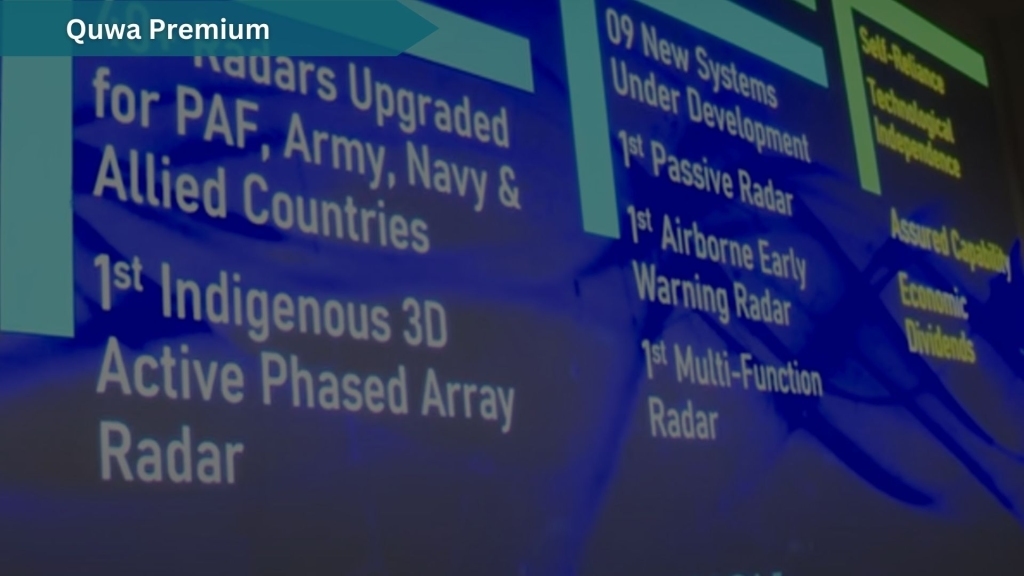
The Pakistan Air Force’s (PAF) National Aerospace Science & Technology Park (NASTP) revealed that it was developing nine new original radar/sensor programs, including a new passive radar, a multi-function radar, and an airborne early warning (AEW) radar.
The disclosure was made in a promotional PAF video recapping the visit of President Asif Ali Zardari at one of NASTP’s facilities.
In addition to new radar projects, NASTP also revealed that it upgraded over 40 radars for the PAF, the Pakistan Army (PA), the Pakistan Navy (PN), and other countries.
This push for sensor control stems from the mid-2010s, when the PAF began fielding its own proprietary tactical data-link (TDL) protocol, Link-17. It was likely at that time the PAF understood the value of pairing its own TDL stack with proprietary radar platforms, ideally from ‘end-to-end’ where the onboard fighter radar and AEW&C radar are both proprietary systems. Not only would they be from a single source, but that source would be Pakistani.
At its simplest level, control over the radar stack would allow the PAF to pair the radar to its choice of platforms and munitions. For example, it can select its preferred platform for the in-house AEW&C project. Likewise, the PAF can integrate its choice of surface-to-air missiles (SAM) to the in-house multi-function radar. Finally, the PAF can opt for air-to-air missiles (AAM) of its preference to its fighter radars.
Quwa Plus
Go Beyond the Headlines on Pakistan’s Defence and Security.
Quwa Plus gives you deeper reporting, briefings, and analysis on Pakistan’s defence programs, foreign policy, national security, and regional strategy. Follow the developments that matter to professionals, analysts, and serious readers tracking Pakistan’s security landscape.