Pakistan Defence Industry

Industry Report: Pakistan’s Electronic Warfare Systems Plus

This report was written by open-source intelligence (OSINT) analyst Farooq (whose other work can be found on X).

As the lines between traditional warfare and counter-unmanned aerial vehicle (C-UAV) operations blur, integrated electronic warfare (EW) systems have emerged as essential and effective assets that operate in the background of most military operations.

The rise of drones has led to the modernization of EW systems to such an extent that now most combat EW (CEW) systems retain a sub-C-UAS capability in addition to traditional jamming roles, such as those of communications.

Pakistan, which had often remained shy from adopting EW at a large scale, seems to be building upon a significant domestic capability to locally produce and use a large portfolio of integrated communications intelligence (COMINT) EW systems.

In the past, foreign original equipment manufacturers (OEM) – notably Rohde & Schwarz (R&S), Siemens (now under Hensoldt), and Elettronica Group (ELT) – dominated Pakistan’s EW landscape, the trend now appears to be shifting towards domestic EW solutions. Three domestic manufacturers are Pakistan’s EW drivers: the National Radio and Telecommunication Corporation (NRTC), the Defence Science and Technology Organization (DESTO), and the National Aerospace Science and Technology Park (NASTP).

Stay up to date with the latest Pakistani defence news with reliable research and accurate forecasting
Click Here

NRTC Mobile Compact DF
NRTC COMINT ECM V2
NRTC COMINT ECM V1

The ESM vehicle consists of a ‘Strategic Direction’ finding system mounted onto a 6×6 vehicle chassis, which covers a frequency range of 30 MHz to 6000 MHz with a bandwidth (BW) of 300MHz. It also offers high DF accuracy while adopting sensitivity and immunity to reflections. The system utilizes two independent DF engines for processing and allows for detection and direction finding of both fixed as well as agile communication signals. ESM can be mounted onto both fixed and mobile platforms.

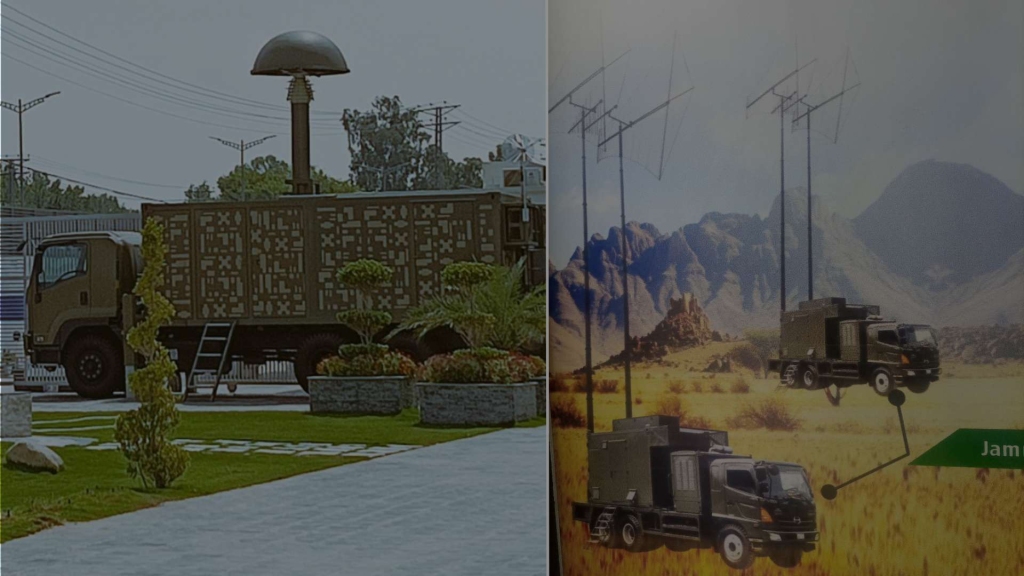
The ECM vehicle consists of a wideband communication jammer mounted onto a Hino chassis, and covers a frequency range of 30 MHz to 6000 MHz with a BW of either 100 or 300MHz. The ECM provides multichannel interception and jamming with a power output of up to 1500 W, and has the ability to use both active and reactive jamming modes against both agile and fixed radio targets. It is able to effectively jam frequency hopping radio nets. Depending on the config it can have between four to six antennas.

NRTC’s ECM Jammer vehicle has been spotted in three different variations so far, with the major differences being the variation in the cabin type being utilized and number of antennas mounted on the dual masts. Additionally the power generation setup used also varies in-between configurations.

NRTC Compact DF System

NRTC also offers a much lighter and ruggedized mobile DF system that be mounted easily onto 4×4 vehicles. The system offers ‘Wideband Frequency Monitoring’ and ‘Automated Direction Finding’ in a large frequency range of 30 MHz to 8000 MHz with a real time BW of 40 MHz in a dense EW environment.

Quwa Plus

Don't Stop Here. Unlock the Rest of this Analysis Immediately

To read the rest of this deep dive -- including the honest assessments and comparative analyses that Quwa Plus members rely on -- you need access.

Join Today

USD $29.99/Year