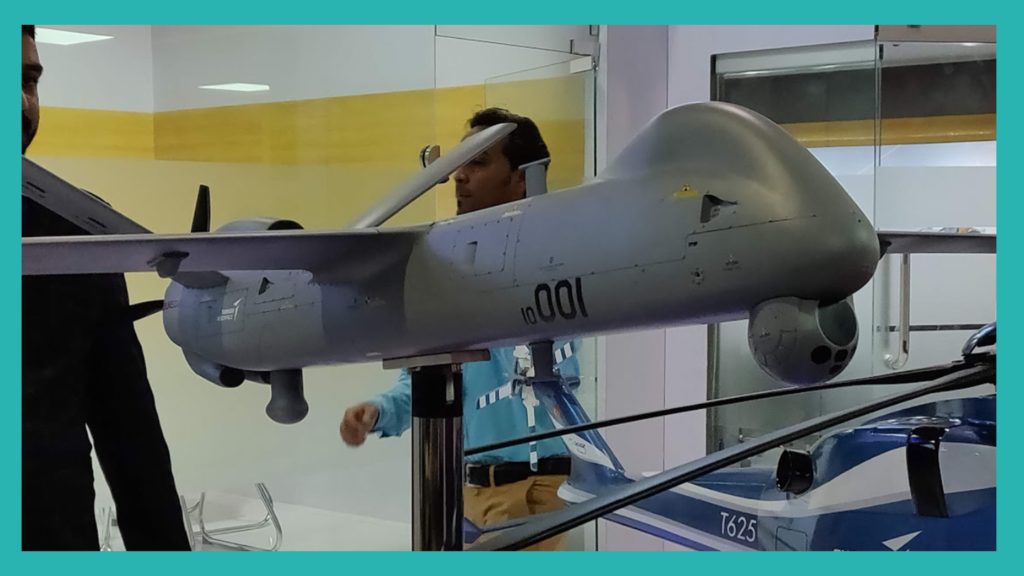
Though a newer entrant in unmanned aerial vehicle (UAV) design and production, Turkey is arguably the first country to extensively use armed drones in conventional operations. In other words, Turkey is setting an example of how to use armed UAVs against opposing military forces both today, and in the future.
In contrast, Pakistan has not yet reached the level Turkey is at in drone design and deployment, despite it actually being ahead of many countries in the early 2000s. There are multiple causes for Pakistan lagging in this area, among them a lack of funding (and focus) for domestic research and development (R&D) until very recently (e.g., 2017, when Pakistan announced Project AZM), the armed forces’ lack of trust in private sector suppliers, and hollow policy support for rapid indigenous UAV development and production.[1]
Turkey, on the other hand, had committed to the opposite action across each of the aforementioned areas – and the results are now paying off into programs that could alter conventional warfare itself. However, Pakistan can still correct its course, but the chances of it making the right changes are slim at this time.
Turkey’s ‘Drone Wars’ in Syria and Libya
Militaries had traditionally used drones for either intelligence, surveillance, and reconnaissance (ISR) and carrying out targeted strikes against non-state actors. In most scenarios, drones were a weapon of choice for counterinsurgency (COIN) and counterterrorism (CT) operations.
UAVs offered a relatively low-cost – and low-risk – pervasive monitoring solution over areas of interest as well as means of inflicting sufficient damage against targets (e.g., strikes against specific individuals). But the leading drone users (e.g., the United States) were reluctant to extend the use of current designs, which are mostly piston or turboprop-powered designs, for conventional operations. The main concern for the U.S. was that it would incur major drone losses (and capability loss) against conventional threats.[2]
Turkey had started out by using its UAVs for COIN and CT, but in recent years, extended drone utilization to conventional operations. Arguably, its most notable use was its drone attacks against Libyan National Army (LNA) Pantsir-S1 air defence systems.[3] Though technically an attack against a conventional system, the Turks still operated in a hybrid/proxy-type of conflict situation, i.e., by supporting specific factions in Libya (or Syria) against opposing groups backed by other players.
In other words, one can argue that Turkey’s use of drones was a means to use air power without escalating the conflict situation in those countries. So, in one sense, its ‘drone war’ may have come out of necessity (to limit escalation) than a game-changing strategy. But nonetheless, its UAVs did degrade a conventional threat (i.e., SAMs), which is a noteworthy achievement, one that Turkey is looking to expand upon.
Turkey’s Drones
Presently, Turkey is relying on two locally developed – and mass-produced – designs to spearhead its operations in Syria and Libya: the Bayraktar TB2 and the Anka-S. Both UAVs are medium-altitude and long-endurance (MALE) designs, but from two different Turkish original equipment manufacturers (OEM).
Bayraktar TB2
Quwa Plus
Go Beyond the Headlines on Pakistan’s Defence and Security.
Quwa Plus gives you deeper reporting, briefings, and analysis on Pakistan’s defence programs, foreign policy, national security, and regional strategy. Follow the developments that matter to professionals, analysts, and serious readers tracking Pakistan’s security landscape.
Join ($29.99/Year) Already a subscriber?Sign in