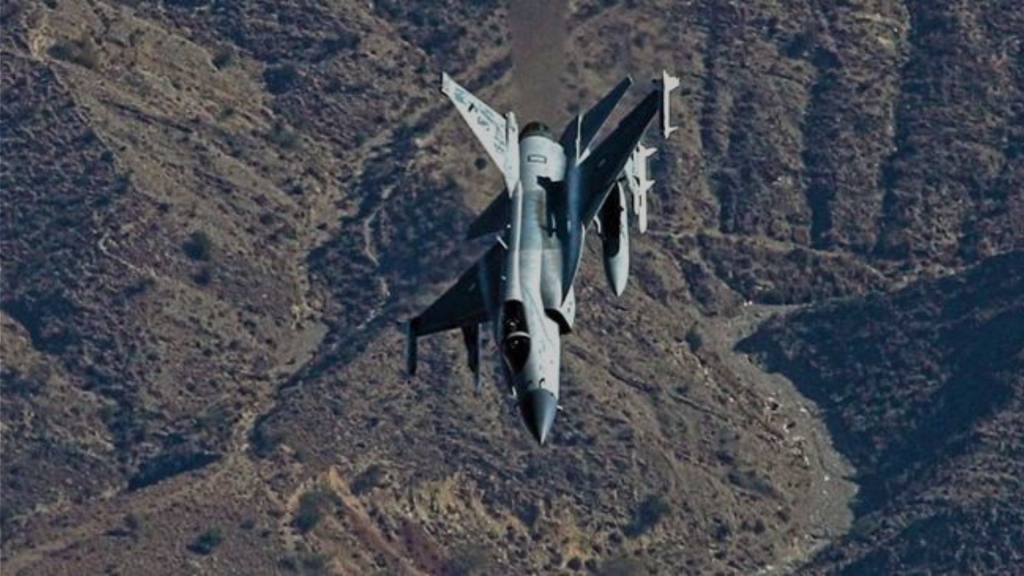
In a promotional video released on 20 August, the Pakistan Air Force (PAF) reported that an Iraqi delegation led by the country’s Ministry of Defence (MoD) “expressed a strong interest” in the JF-17 Thunder, a multi-role fighter jointly produced by Pakistan Aeronautical Complex (PAC) and Aviation Industry Corporation of China (AVIC).
Currently, there is no order from Iraq. However, the report signifies yet another attempt on the PAF’s part to market the Thunder. This follows its ongoing efforts to land a big-ticket sale to Azerbaijan as well as a follow-on order from Nigeria.
A sale to any of these three countries would be a boon for PAC, which will soon finish the current order of 30 JF-17C Block-IIIs by the PAF. In lieu of an additional PAF order, a big-ticket export will be key to keeping PAC’s prod
Stay up to date with the latest Pakistani defence news with reliable research and accurate forecasting
Click Here
It is worth noting that the markets that the Gripen and F/A-50 excel in are those that are aligned with the Western world. One would need the tacit approval of Britain and the United States to procure or sell both of these platforms. Thus, the one realm the JF-17 could potentially find a market would be the one where a Western platform cannot compete in. Moreover, with Russia currently factored out of securing big-ticket fighter sales due to its invasion of Ukraine, the time for Chinese fighter options to capture market-share could not be any better.
Thus, the JF-17 can offer a compelling package for those that want current air warfare capabilities, but at an accessible cost and without the US/UK regulatory restrictions.
These capabilities would entail, most notably, the inclusion of an active electronically scanned array (AESA) radar paired with a BVR AAM boasting a stated range of 145 km, a helmet-mounted display and sight (HMD/S) system coupled with a high off-boresight (HOBS) AAM, and a growing inventory of stand-off range PGMs, including air-launched cruise missiles (ALCM).
In effect, a JF-17 buyer could get a credible air-to-air package alongside a strategically-impactful air to surface capability (for example, the Taimur ALCM offers a range of up to 280 km). Not only is the solution free of regulatory systems like ITAR, but Pakistan can even control some aspects, like the air-to-surface munitions stack and, potentially, AAMs in the future.
This offers countries with tenuous defence ties with the West, such as Iraq and Algeria, an option for keeping their respective air forces up to date. In fact, Chinese solutions as a whole can provide this option, so the prospects of a J-10CE or even J-31 deal should be higher as well.
Quwa Plus
Go Beyond the Headlines on Pakistan’s Defence and Security.
Quwa Plus gives you deeper reporting, briefings, and analysis on Pakistan’s defence programs, foreign policy, national security, and regional strategy. Follow the developments that matter to professionals, analysts, and serious readers tracking Pakistan’s security landscape.
Join ($29.99/Year) Already a subscriber?Sign in