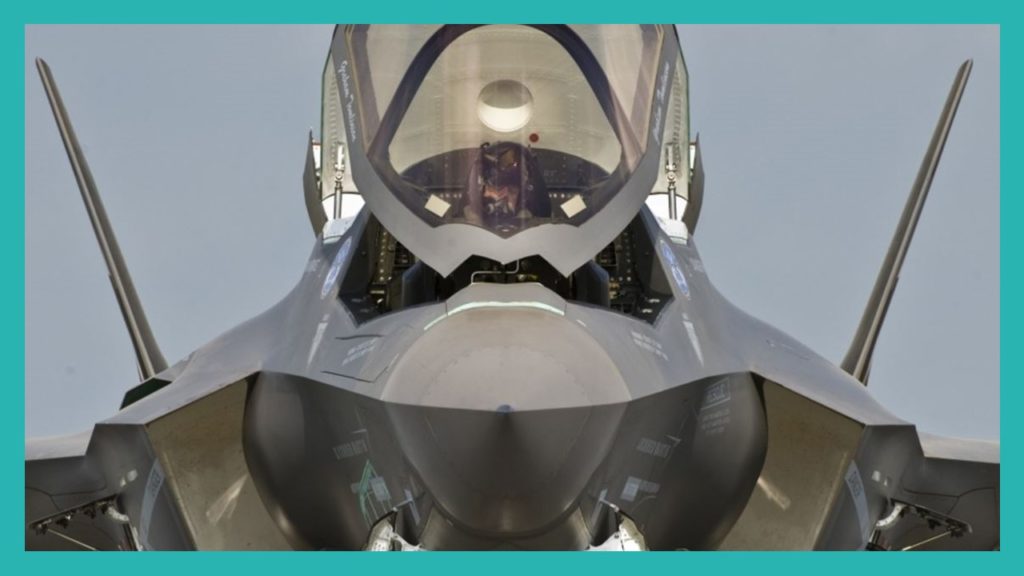
On 13 August 2018, US President Donald Trump signed into law the 2019 National Defence Authorization Act, a $716 billion bill outlining the US’ fiscal defence priorities for the next year. A marquee aspect of the Act, and one of significant contention, is the stay on delivering the first of Turkey’s Lockheed Martin F-35 Lightning II fighters to Ankara. Although Washington had alluded to blocking the fighter in response to the Turkish government’s decision to procure Almaz-Antey S-400 Triumf long-range air defence systems from Russia, Ankara’s arrest of American pastor Andrew Brunson served as a final catalyst.
However, Turkey is not simply a customer of the F-35. Rather, it is an equity partner that had contributed to the development of the aircraft and, in turn, wields a range of workshare rights in the program. In fact, the F-35’s Joint Program Office has outlined that it “will continue to execute current program plans”, thus indicating the surprising nature of Washington’s move (such that the F-35 Joint Program Office has yet to plan, much less execute, an alternate course).[1] It is unclear if Washington will commit to the stay, though it has conditioned its move on the arrest of Brunson and – to a lesser degree – Turkey’s S-400 purchase.
Although there is a chance the F-35 issue could pass (with Turkey ultimately receiving its fighters), an issue of this significance – i.e. directly impacting Turkey’s defence programs, even where co-development and industrial workshare are factors – could see Ankara recalibrate how it develops its defence industry from this point on. In fact, a series of ongoing factors – from Washington’s policies to Turkey’s macroeconomic challenges – could spur alternate approaches to product design and overseas partners.
Background
In terms of the background – or lead-up of factors that resulted in the current predicament – one should consider two underlying issues. First, Turkey’s participation in the F-35 and how its approach in that area reflects its overall strategy for domestic defence industry development. Second, the assumption that the Turkish government had held regarding its state-to-state ties with the US.
Turkey’s F-35 Lightning II Program
Turkey formally joined the Joint Strike Fighter (JSF) program in 2002 in a memorandum-of-understanding (MoU) worth $175 million US.[2] However, much like Canada – itself a participant in the JSF’s development and co-production – Turkey signing onto the JSF did not necessarily mean it would order aircraft (though it was well-positioned to do so). Rather, its first formal orders came in recent years, i.e. in May 2014 for two F-35A aircraft, which were supposed to have been delivered if not for Washington’s stay-order.[3]
Quwa Plus
Go Beyond the Headlines on Pakistan’s Defence and Security.
Quwa Plus gives you deeper reporting, briefings, and analysis on Pakistan’s defence programs, foreign policy, national security, and regional strategy. Follow the developments that matter to professionals, analysts, and serious readers tracking Pakistan’s security landscape.
Join ($29.99/Year) Already a subscriber?Sign in