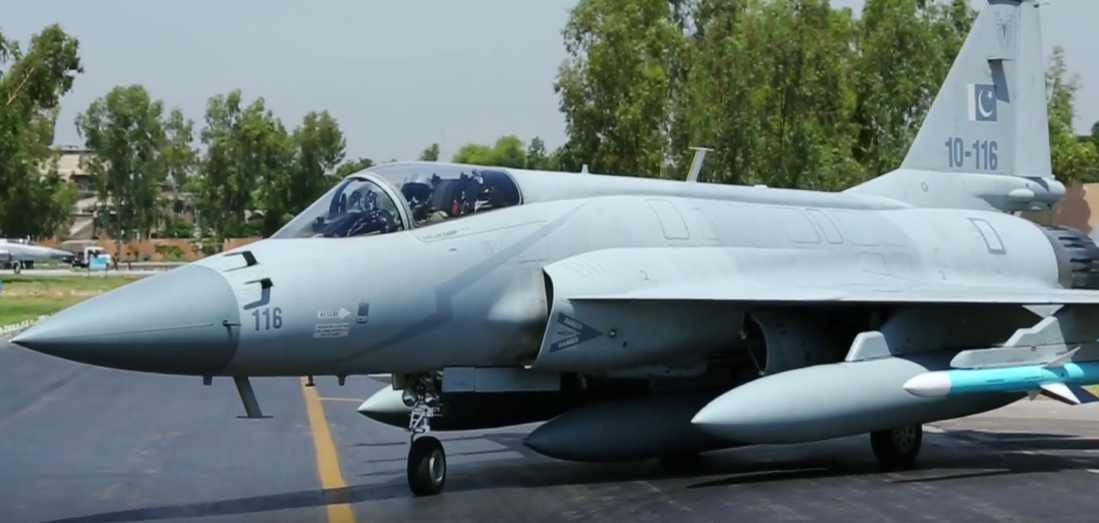
Myanmar is currently negotiating for the local licensed production of JF-17 Thunder lightweight multi-role fighters, IHS Jane’s reports.
In July 2015, Myanmar became the first third-party customer of the JF-17, which is co-produced by the Pakistan Aeronautical Complex (PAC) and Chengdu Aircraft Industry Group (CAIG), with an order of 16 JF-17 Block-II fighters. As of January 2017, PAC produced more than 30 JF-17 Block-IIs.
Go deeper into the defence market.
Research on procurement, emerging technology and the industry behind the news.
IHS Jane’s learned that Myanmar is interested in producing the JF-17 Block-III, which is envisaged to be equipped with an active electronically-scanned array (AESA) radar, helmet-mounted display and sight (HMD/S) system, and potentially infrared search and track (IRST) system.
Notes & Comments:
Specifics, such as the number of additional JF-17s, the sub-systems, extent of local production (e.g. parts manufacturing or assembly), or the desired timeline for initiating production, are not known.
The Block-III is the JF-17’s first major iterative update and the nature of its subsystems are beginning to be understood. During Air Show China 2016, Nanjing Research Institute of Electronics Technology (NRIET) unveiled its KLJ-7A AESA radar, which is reportedly capable of tracking 15 targets and engaging 4 at once. The Chinese industry is also offering a diverse range of munitions, especially guided air-to-ground bombs and missiles, for its export fighters, such as the JF-17.
As per Flight Global’s World Air Forces (2016), Myanmar has 16 A-5s and 24 F-7s. Assuming a 1:1 replacement ratio with the JF-17, the Myanmar Air Force could procure roughly 24 JF-17 Block-IIIs. This is generally too small a number for feasible domestic manufacturing, though local assembly is plausible.
One could see Myanmar pursue domestic capacity for integration purposes (i.e. to select subsystems from sources that are inaccessible to Pakistan) more so than actual manufacturing. For example, the Myanmar Air Force could theoretically seek subsystems from Israel, which is one of its leading defence suppliers. Elbit’s Targo HMD/S and Rafael’s munitions, electronic warfare and electronic countermeasures systems could also be strong candidates for a Myanmar JF-17 Block-III.
If brought to fruition, this could be a significant sale for PAC and the Aviation Industry Corporation of China (AVIC), which have been jointly marketing the JF-17 to many prospective third-party buyers. They secured a sale of three fighters to Nigeria in 2016 and are aiming to close a sale to Azerbaijan. These negotiations with Myanmar would mean that the sale of a substantial number of JF-17s are on the line in 2017.